

Why Do We Dream?
You wake up in the middle of the night convinced you were somewhere else entirely, doing something that made complete sense five seconds ago and none at all now. Maybe you were flying over your childhood neighborhood. Maybe you were back in a classroom you haven’t seen in twenty years, taking a test you never studied for. Either way, your brain built an entire world while your body lay perfectly still, and now you’re left wondering why do we dream in the first place.
That question, why do we dream, has followed humans for thousands of years. Ancient civilizations treated dreams as messages from the gods. Modern sleep researchers treat them as a window into how the brain processes memory, emotion, and even survival instincts. Scientists still don’t have one single, fully agreed-upon answer to why do we dream, but decades of sleep research have uncovered several strong explanations for what dreams are actually doing behind the scenes.
Quick Answer
Why do we dream? We dream mainly because the brain stays highly active during sleep, especially during REM sleep, when it processes emotions, consolidates memories, and rehearses possible scenarios. Leading theories suggest dreaming helps regulate emotions, strengthen learning, and may even prepare the brain for real-life threats.
Key Takeaways
✔ Dreams occur throughout sleep, but the most vivid dreaming happens during REM sleep
✔ The brain stays remarkably active during REM sleep, even though the body remains mostly paralyzed
✔ Leading theories on why we dream link the process to memory consolidation, emotional processing, and threat rehearsal
✔ No single theory fully explains why we dream, and scientists still debate the exact purpose
✔ Nearly everyone dreams every night, even people who never remember doing so
✔ Nightmares and recurring dreams often relate to stress or unresolved emotional experiences
Table of Contents
- What Actually Happens in Your Brain When You Dream
- The Leading Theories on Why We Dream
- Why Some Dreams Feel So Real
- Why We Forget Most of Our Dreams
- What Nightmares and Recurring Dreams Might Mean
- Do Animals Dream Too?
- Myth vs Fact
- Quick Tips for Remembering Your Dreams
- Frequently Asked Questions
What Actually Happens in Your Brain When You Dream
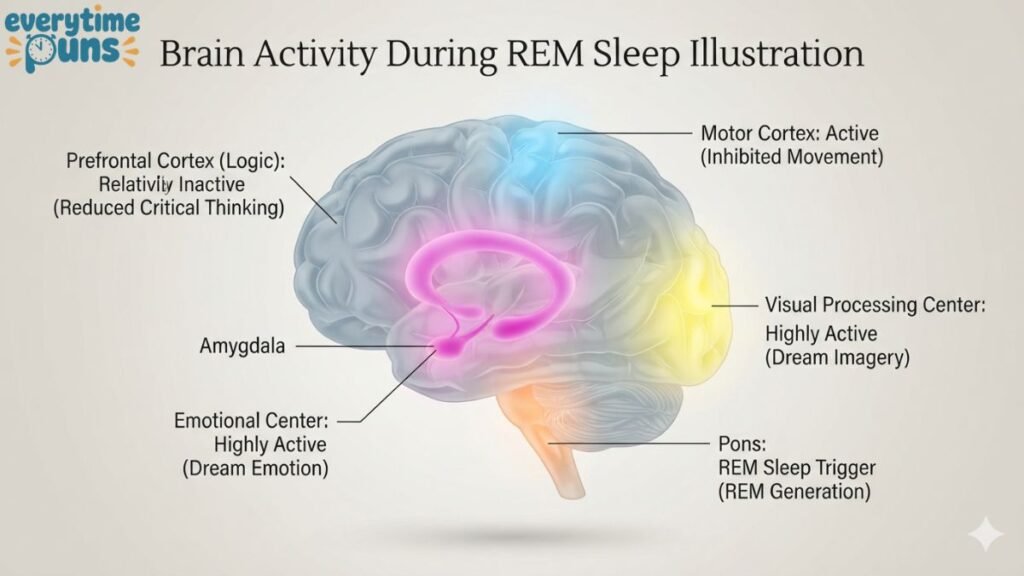
Most people assume the brain quiets down once you fall asleep. The reality is almost the opposite, and it’s the first clue toward answering why do we dream at all.
Sleep moves through several stages, and the one most closely tied to dreaming is REM sleep, short for rapid eye movement. During REM, brain activity looks remarkably similar to when you’re wide awake. Your eyes dart back and forth beneath closed lids, your heart rate shifts, and regions involved in emotion and memory light up noticeably.
At the same time, your body enters a state called REM atonia, where your muscles become temporarily paralyzed. Sleep researchers have found that this likely prevents you from physically acting out whatever your brain is busy simulating. Without it, a dream about running from something might turn into an actual sprint across the bedroom.
Learn more about why do we get hiccups, another involuntary reflex your body handles automatically while you’re not paying attention.
The Leading Theories on Why We Dream
Here’s where things get more interesting. No single theory has settled the question of why do we dream completely, but a few explanations currently carry the most scientific weight.
Memory consolidation is one of the strongest supported ideas. Neuroscientists explain that REM sleep helps the brain sort through the day’s experiences, strengthening important memories while letting less useful details fade. Dreaming may be a side effect of this sorting process, almost like watching fragments of files being reorganized on a hard drive overnight.
Emotional regulation is another leading explanation for why we dream. Clinical psychologists explain that dreaming may help process difficult emotions in a lower-stakes environment, which could explain why anxiety, grief, or unresolved stress often show up in dream content, sometimes in strange or symbolic ways.
Threat rehearsal theory proposes something more evolutionary. This theory suggests dreaming may have developed as a way to mentally rehearse dangerous or challenging situations, giving early humans a kind of practice run for real-world threats without any actual risk involved.
None of these theories fully cancels out the others. Many sleep researchers now believe dreaming likely serves more than one purpose at once, rather than a single clean function that answers why do we dream in isolation.
200+ Best Owl Puns, Jokes & One-Liners That Are Owl-somely Funny (2026)
Why Some Dreams Feel So Real
You may have noticed that certain dreams feel indistinguishable from real life, while others feel obviously strange the moment you wake up. This inconsistency is actually part of the answer to why do we dream the way we do.
During REM sleep, the brain’s logic and self-awareness centers, particularly in the prefrontal cortex, become less active. That’s part of why dreams can feature impossible events, like flying or talking to someone who has passed away, without your brain flagging anything as unusual while it’s happening. Meanwhile, the areas responsible for vision, emotion, and memory stay highly active, which is why dreams can feel vivid, emotional, and startlingly real.
💡 Did You Know?
Some researchers believe the strange, illogical nature of dreams isn’t a flaw at all. It may actually reflect the brain testing unusual and creative connections between memories, which is one reason people sometimes wake up with a genuinely new idea or solution to a problem they were stuck on the day before.
Why We Forget Most of Our Dreams

Even though nearly everyone dreams multiple times a night, most people wake up remembering very little, if anything at all. This is one of the more frustrating parts of trying to understand why do we dream, since so much of it disappears before we can examine it.
This comes down to brain chemistry. During REM sleep, levels of certain neurotransmitters involved in forming long-term memories drop significantly. That makes it harder for the brain to properly store dream content the way it stores memories from waking life. Dreams that occur closer to waking, especially the last one before you get up, tend to be remembered more clearly simply because there’s less time for that memory to fade before your conscious mind takes over.
What Nightmares and Recurring Dreams Might Mean

A nightmare that jolts you awake or a dream that keeps repeating night after night usually isn’t random. It often ties directly back to why we dream in the first place.
Nightmares often spike during periods of high stress, anxiety, or major life changes, and they tend to reflect whatever emotional load the brain is currently processing. Recurring dreams, meanwhile, often point to something unresolved. If the same scenario, like missing an important event or being unprepared for a test, keeps showing up, it may be worth paying attention to what that situation represents in your waking life rather than the literal dream content itself.
Occasional nightmares are normal and not usually a cause for concern. However, if nightmares happen frequently enough to disrupt sleep or daily functioning, it may be worth discussing with a doctor or sleep specialist.
Do Animals Dream Too?

If you’ve ever watched a sleeping dog twitch its paws and make small noises, you’ve likely wondered whether it was dreaming, and whether the same reasons behind why humans dream might apply to animals too.
Animal behavior experts note that many mammals, including cats, dogs, and even some birds, go through REM sleep, complete with the same brain activity patterns seen in humans. While researchers can’t confirm exactly what animals experience during these episodes, the presence of REM sleep strongly suggests that dreaming isn’t unique to humans, and may be a much older feature of the brain than previously assumed.
Myth vs Fact
Myth | Fact |
Dreams only happen during REM sleep | Dreams can occur in other sleep stages too, though REM dreams tend to be the most vivid and memorable |
Dreams predict the future | There’s no scientific evidence supporting dreams as predictions, though they can reflect current worries |
Everyone dreams in color | Most people do dream in color, but a smaller percentage report dreaming mostly in black and white |
Only humans dream | Many animals show REM sleep patterns similar to humans, suggesting they may dream as well |
Quick Tips for Remembering Your Dreams

✓ Keep a notebook or notes app by your bed to record dreams immediately after waking
✓ Try waking up naturally instead of with a jarring alarm when possible
✓ Stay still for a few moments after waking before reaching for your phone
✓ Write down even small fragments, since full recall often builds from partial memories
✓ Avoid alcohol close to bedtime, since it can reduce REM sleep and dream recall
Frequently Asked Questions
Why do I only remember some of my dreams?
Dream recall depends heavily on when you wake up relative to REM sleep. Dreams closer to your waking moment are easier to remember, while earlier ones fade quickly due to changes in brain chemistry during REM sleep. This is one of the more practical angles on why do we dream yet forget so much of it.
Can what I eat or watch before bed affect my dreams?
Yes. Stress, screen time, and even certain foods before bed can influence dream content and intensity. Spicy foods and late-night stress have both been linked to more vivid or unsettling dreams in some studies, which ties back to the emotional regulation theory of why we dream.
Is it normal to have the same dream repeatedly?
Yes, recurring dreams are common and often tied to unresolved stress or ongoing life situations. According to current research, they tend to fade once the underlying issue is addressed or resolved in waking life.
Do we dream every night even if we don’t remember it?
Most sleep researchers agree that dreaming happens during nearly every sleep cycle, regardless of whether you remember it afterward. Memory of dreams depends more on timing and brain chemistry than on whether dreaming actually occurred that night.
Why do dreams often feel so strange or illogical?
During REM sleep, the brain’s logic and self-monitoring centers become less active while emotional and visual centers stay highly engaged. This combination allows dreams to feel vivid and emotionally intense while bypassing normal logical checks, which is a key part of why do we dream in such unpredictable ways.
Conclusion
Dreaming remains one of the few experiences that happens to nearly everyone every night, yet somehow still resists a single, complete explanation. What science does show is that why do we dream isn’t a question with a random answer. It’s tied closely to how your brain manages memory, emotion, and even problem-solving while your body rests. The next time you wake up from a dream that made no sense five minutes ago, you’ll at least know your brain wasn’t malfunctioning. It was doing exactly what brains have been built to do for millions of years.

I am writer who believes life is better when you add a little wordplay to it. For the past four years, I have been creating content in the Puns and Humor niche, turning simple ideas into clever jokes and playful lines.