
Teal Pumpkin Meaning is simple: a teal-colored pumpkin displayed outside a home on Halloween signals that non-food treats are available for trick-or-treaters. Instead of receiving only candy, children can choose small toys, stickers, glow sticks, or other fun surprises.
This welcoming Halloween tradition is part of the Teal Pumpkin Project, an initiative supported by Food Allergy Research & Education (FARE). It helps children with food allergies, dietary restrictions, and other needs participate in trick-or-treating without feeling excluded.
But there’s more to this special Halloween symbol than its beautiful blue-green color.
If you’ve spotted a teal pumpkin on someone’s porch and wondered what it represents, this guide explains its meaning, history, safety considerations, and how your family can participate in Halloween 2026.
Quick Answer: A teal pumpkin means a household offers non-food Halloween treats. It does not necessarily mean the home or any candy being offered is completely allergen-free.
What Does a Teal Pumpkin Mean on Halloween?
The Teal Pumpkin Meaning centers on one important idea: Halloween should be enjoyable and welcoming for every child, including those who cannot safely eat certain foods.
During traditional trick-or-treating, children visit neighboring homes and receive candy. However, some children cannot safely eat common Halloween sweets because of food allergies, intolerances, or other medical and dietary needs.
A teal pumpkin placed near a front door tells visiting families that another option is available.
Instead of receiving candy, children can collect a small non-food surprise, such as a colorful pencil, Halloween sticker, or glow bracelet.
What Does a Teal Pumpkin Outside a House Represent?
It usually communicates three things:
- Inclusivity: Children with different dietary needs are welcome.
- Non-food treats: The household offers alternatives to candy.
- Food allergy awareness: The homeowner supports a more inclusive Halloween experience.
The symbol is especially meaningful to families managing serious food allergies, but anyone can participate in the tradition.
A teal pumpkin is not a medical certification, and it does not guarantee that the surrounding environment contains no allergens.
Is a Teal Pumpkin Different From a Regular Halloween Pumpkin?
Yes, in its intended message.
Traditional orange pumpkins are generally used as seasonal decorations, while teal pumpkins have a specific association with the availability of non-food Halloween treats.
Both can appear together on the same porch.
For example, a homeowner might display several carved orange jack-o’-lanterns alongside one teal pumpkin and a small sign explaining the available treats. Families who enjoy decorating pumpkins can also explore our pumpkin puns for playful Halloween sign ideas and seasonal captions, while keeping the non-food treat message clearly visible.
The teal pumpkin makes the welcoming message easier for visiting families to recognize.
What Is the Teal Pumpkin Project?
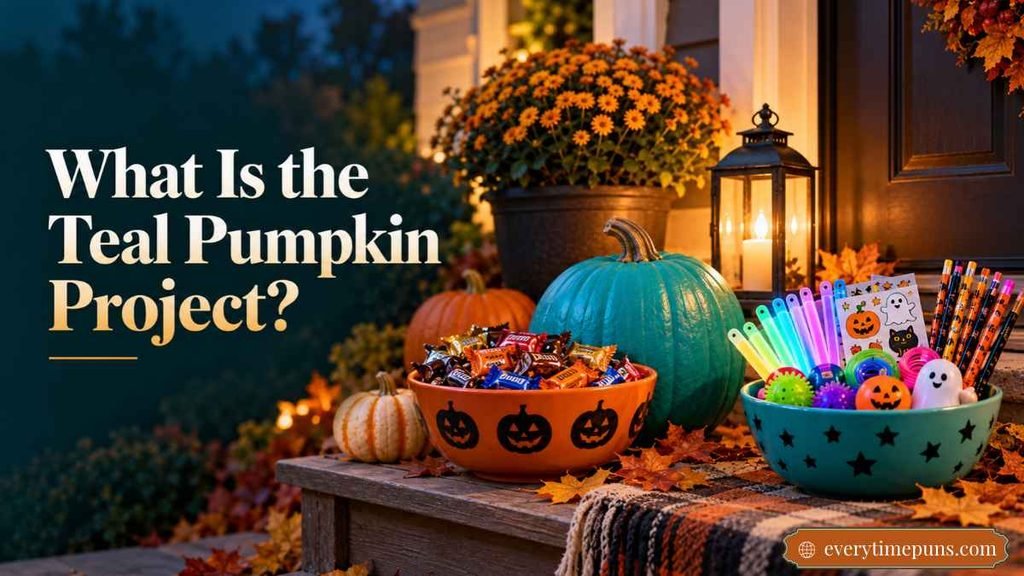
The Teal Pumpkin Project is a Halloween awareness initiative organized by Food Allergy Research & Education (FARE).
Its purpose is to encourage families, schools, businesses, and communities to make Halloween celebrations more inclusive by offering non-food alternatives to candy.
The initiative does not ask people to stop giving out sweets. Instead, it encourages the addition of another treat option.
Why Is the Teal Pumpkin Project Important?
Many popular Halloween candies contain ingredients such as milk, peanuts, tree nuts, soy, eggs, or wheat.
For children with food allergies, consuming an allergen can cause an allergic reaction, sometimes a severe one.
Small Halloween candy packages may also have different ingredient information or less visible labeling than larger packages.
Non-food treats provide a practical alternative for children who cannot safely enjoy certain candies.
FARE explains that these options may also benefit children with other dietary or medical considerations.
Who Benefits From the Project?
The initiative is helpful for:
- Children with food allergies or food intolerances.
- Children with celiac disease or other dietary restrictions.
- Children whose medical needs make eating traditional candy difficult.
- Families looking for non-food Halloween activities.
- Any trick-or-treater who simply enjoys receiving toys or small surprises.
One of the best features of the project is that children do not need to explain their medical history to receive a non-food treat.
Offering everyone a choice helps make the experience more comfortable.
Why Is Teal the Color for Food Allergy Awareness?
Understanding the color is an important part of understanding Teal Pumpkin Meaning.
Teal is a blue-green color widely associated with food allergy awareness.
The shade is visually distinctive and stands out among the orange, black, and purple decorations traditionally used during Halloween.
By connecting this recognizable color with a pumpkin, the awareness campaign created an easy-to-understand seasonal symbol.
What Does the Teal Color Symbolize?
Within this Halloween initiative, teal represents awareness, consideration, and inclusion.
Its role is practical as well as symbolic.
A teal decoration gives families a visual clue that they may find something other than candy at a participating home.
However, the symbol works best when homeowners understand its meaning and actually have non-food treats available.
Why Not Use a Different Pumpkin Color?
Different pumpkin colors can be used for various decorative purposes or awareness messages, but the Teal Pumpkin Project specifically uses teal.
Using the established color consistently makes the campaign easier to recognize.
If you want to participate, choose a clearly teal-colored pumpkin or an official printable sign rather than relying on an unfamiliar color.
How Did the Teal Pumpkin Project Start?
The project grew from a community-based food allergy awareness effort in East Tennessee.
The Food Allergy Community of East Tennessee (FACET) helped inspire the activity, which encouraged households to provide non-food treats so children with allergies could enjoy Halloween.
The idea gradually attracted broader attention because it offered a simple way for communities to make trick-or-treating more inclusive.
In 2014, FARE expanded the initiative nationally, helping spread awareness beyond its original local community.
How Did the Movement Become Popular?
The concept is easy to understand and relatively inexpensive to follow.
Families can participate by making just a few changes to their Halloween preparations.
They do not need expensive decorations, elaborate events, or specialized equipment.
A teal pumpkin, a selection of appropriate non-food treats, and a willingness to welcome every child are enough to take part.
Social media, schools, community organizations, and local Halloween events have helped raise awareness of the campaign.
Is the Teal Pumpkin Project Still Relevant in 2026?
Yes.
The underlying need remains important because food allergies and dietary restrictions continue to affect families.
For Halloween 2026, households can participate by using FARE’s project resources, displaying a teal pumpkin, and preparing non-food alternatives.
Even one participating household can offer a more welcoming experience for children visiting that neighborhood.
How to Participate in the Teal Pumpkin Project in 2026
You don’t need to organize a major event to participate.
The most effective way to support the initiative is to prepare a clear display and give children suitable non-food choices.
Step 1: Choose Your Teal Pumpkin
You can paint a real pumpkin teal, buy a reusable teal decoration, or display a printed teal pumpkin sign.
Select something easy to see from the sidewalk.
Step 2: Prepare Non-Food Halloween Treats
Choose small, enjoyable items suitable for the age groups likely to visit your home.
Stickers, pencils, bookmarks, and age-appropriate toys are convenient choices.
Try to have enough for the number of trick-or-treaters you expect, but remember that participation does not require expensive purchases.
Step 3: Keep Candy and Non-Food Items Separate
If you also want to distribute candy, prepare two separate containers.
Place food treats in one bowl and non-food items in another.
This reduces unnecessary contact between the two categories and makes it easier for visitors to choose.
Step 4: Display a Clear Halloween Sign
A small sign can make your setup more understandable. Keep the main message easy to read so families know non-food treats are available. If you want to make your porch display more cheerful, our Halloween puns offer playful ideas for an additional festive greeting without distracting from the important allergy-awareness message.
For example:
“Non-Food Halloween Treats Available Here!”
You can also use the official printable materials provided by FARE.
Step 5: Share the Information With Your Community
Let neighbors, friends, and local parent groups know that your household is participating.
You can also check FARE’s official Teal Pumpkin Project Map and add your address or participating event if you choose.
Sharing information before Halloween helps families plan their celebrations.
Step 6: Welcome Every Trick-or-Treater
When children visit, offer your available treat choices without asking them to disclose an allergy or medical condition.
Keep the interaction friendly and simple.
A child who prefers a sticker over chocolate should feel just as welcome as anyone else.
Best Non-Food Halloween Treats for Kids
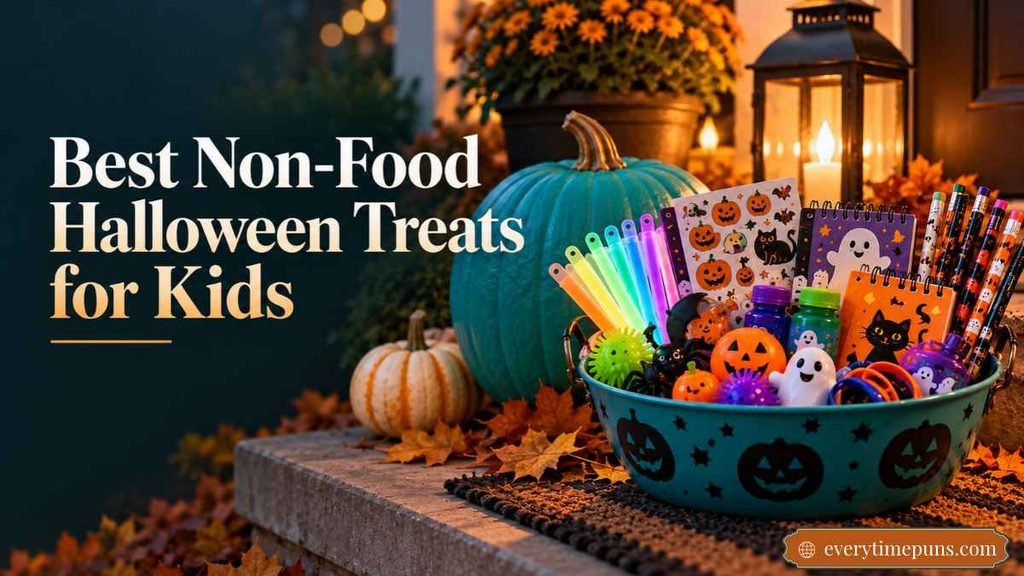
A practical part of Teal Pumpkin Meaning is knowing what kinds of treats to offer.
The best options are affordable, enjoyable, easy to distribute, and appropriate for the child’s age.
FARE recommends various small toys, school supplies, and novelty items as alternatives to traditional candy.
15 Fun Non-Food Halloween Treat Ideas
| Non-Food Treat | Why Kids May Enjoy It |
| Halloween stickers | Fun for decorating notebooks and crafts |
| Glow sticks | Colorful accessories for Halloween night |
| Glow bracelets | Wearable surprises with festive colors |
| Pencils | Useful at home or school |
| Mini notebooks | Great for drawing or writing |
| Bookmarks | Fun for children who enjoy reading |
| Crayons | Encourage coloring and creativity |
| Halloween erasers | Small, practical school accessories |
| Finger puppets | Encourage imaginative play |
| Mini stencils | Useful for art projects |
| Bubble bottles | A playful outdoor activity |
| Mini playing cards | Useful for simple family games |
| Pencil toppers | Add personality to school supplies |
| Halloween-themed stamps | Fun for crafts and decorations |
| Mini coloring cards | Encourage quiet creative activities |
These are suggestions, not a guarantee that every product is suitable for every child.
Always review packaging, materials, and age recommendations before distributing toys.
Best Treats for Younger Children
For toddlers and preschool-age children, choose products specifically labeled as suitable for their age.
Avoid loose small parts that could cause choking.
Larger stickers, suitable crayons, and properly age-rated art supplies may be more appropriate than tiny novelty toys.
Parents should supervise children when using unfamiliar items.
Best Treats for Older Kids
School-age children may enjoy glow bracelets, Halloween pencils, mini notebooks, bookmarks, or small activity items.
Choose products that are easy to carry while trick-or-treating.
Practical items that children can use after Halloween may also be especially appreciated. For an extra creative non-food surprise, parents can include a small printed joke card with a Halloween activity pack. Our collection of clean puns for kids offers family-friendly wordplay that can make these little surprises even more entertaining.
Are All Non-Food Treats Allergy-Safe?
Not necessarily.
Some non-food products contain materials associated with allergies.
For example, certain modeling clays contain wheat, and some novelty products may contain latex.
Read labels carefully and consider choosing latex-free products where possible.
Also avoid distributing damaged glow sticks or products that could leak or break easily.
Can You Give Out Candy and Non-Food Treats Together?
Yes, you can offer both candy and non-food items while participating in the Teal Pumpkin Project.
This is one of the most common questions from homeowners.
The project is designed to add an inclusive alternative, not eliminate traditional Halloween candy.
How Should You Organize Your Treat Bowls?
Use two clearly separated containers.
One should contain candy, while the other holds non-food alternatives.
Keep the bowls apart and avoid placing loose toys directly among unwrapped food.
If possible, allow each visitor to choose between the available options.
A simple sign saying “Candy or Prize — You Choose!” can make the arrangement more inviting. If you’re decorating a separate candy bowl or Halloween treat table, you can find playful wording in our candy puns collection. Just make sure the candy and non-food options remain clearly labeled and physically separated.
Should You Ask Children About Their Allergies?
You do not need to ask for personal medical information.
Instead, you can simply say:
“Would you like candy or a non-food treat?”
This gives children and their caregivers a choice without making anyone feel singled out.
Caregivers should make decisions about which items are suitable for children with allergies.
Does a Teal Pumpkin Mean Candy Is Allergy-Free?
No.
The teal pumpkin indicates that non-food treats are available.
It does not certify that any candy offered at the home is free from allergens.
Families managing food allergies should still examine packaged food carefully and follow their established allergy management plans.
Helpful Halloween Safety Tips
Parents and caregivers may wish to:
- Check food labels before children eat collected candy.
- Be cautious with candy that lacks complete ingredient information.
- Avoid sharing unverified food items.
- Inspect toys for age suitability and damaged parts.
- Follow the child’s prescribed allergy emergency plan.
These precautions complement the Teal Pumpkin Project rather than replace medical guidance.
How to Make and Display a Teal Pumpkin at Home
Creating your own teal pumpkin can be a simple Halloween craft.
You can use a real pumpkin, a reusable artificial one, or a printed sign.
The important part is making the message recognizable.
DIY Teal Pumpkin Decoration
If you want to paint a real pumpkin, follow these steps:
- Choose a clean, dry pumpkin with a stable base.
- Place a newspaper or a protective covering under your work area.
- Apply suitable teal-colored craft paint according to the manufacturer’s instructions.
- Allow the paint to dry completely.
- Add simple decorations if desired.
- Place the pumpkin near your front door where visitors can see it.
A real pumpkin is not required. Reusable decorations are a convenient option for families who want to participate each year.
Where Should You Place Your Pumpkin?
Choose a visible location near the entryway.
For example, you could place it beside your doorstep, on a porch table, or near a clearly displayed Halloween sign.
Avoid blocking walkways or placing decorations where children may trip.
Battery-operated LED lighting can help illuminate the display after sunset.
Can You Participate Without Painting a Pumpkin?
Absolutely.
FARE provides printable signs that identify participating homes.
You can attach one to your front door or place it in a visible window.
The sign is useful for families who want a quick, inexpensive way to participate.
This option also makes the project more accessible to apartment residents, schools, community centers, and businesses.
Where to Find Teal Pumpkin Project Homes Near You
Knowing Teal Pumpkin Meaning can help families recognize participating homes while planning their Halloween activities.
The official Teal Pumpkin Project provides a map feature intended to help families locate participating homes and events.
How to Use the Teal Pumpkin Project Map
From there, open the project map and look for participating locations in your area.
If the map supports searching your city or ZIP code, use those options to narrow the results.
You may also be able to register your home or community event.
Check the available map instructions before submitting any information.
What If No Participating Homes Appear Nearby?
An empty or limited map does not necessarily mean no one in your neighborhood offers non-food treats.
Some participating households may not have registered their addresses.
You can also check with local community groups, parent organizations, schools, or event organizers.
If your area has few participating locations, consider sharing information about the project with neighbors.
Even a handful of participating households can make Halloween more welcoming.
Tips for Families Planning Halloween Night
If your child has food allergies, discuss treat choices before leaving home.
Bring a suitable collection bag for non-food items, review the planned route, and establish expectations about checking candy before it is eaten.
Parents should continue following the child’s usual allergy safety precautions regardless of the decorations displayed outside a home.
Teal vs. Blue Pumpkins: What’s the Difference?
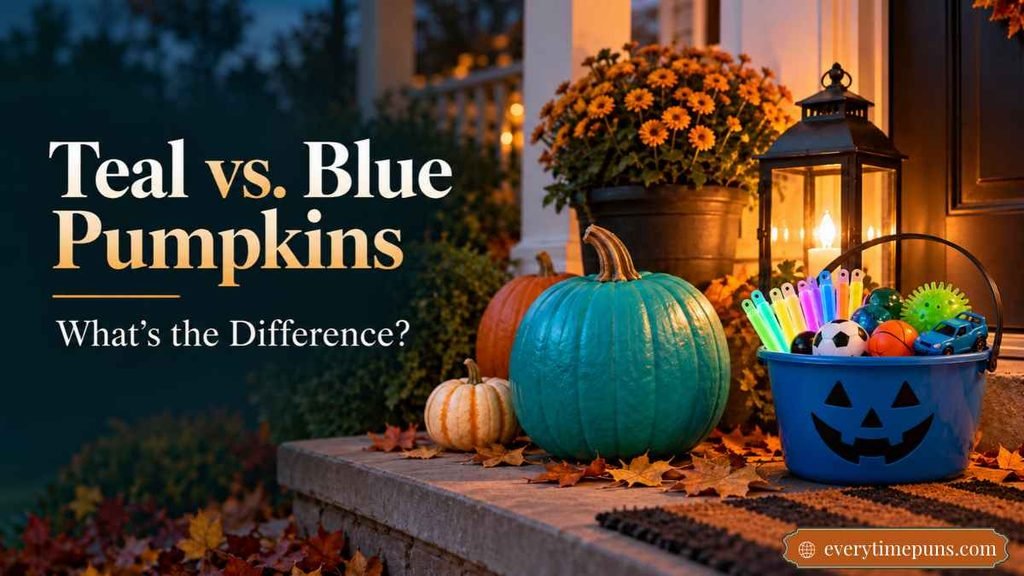
One common source of confusion involves teal pumpkins, blue pumpkin buckets, and other Halloween colors.
Although the colors can appear similar, they do not necessarily communicate the same message.
Teal Pumpkins and Food Allergy Awareness
The established Teal Pumpkin Meaning refers to non-food treat availability.
It is connected with FARE’s organized food allergy awareness initiative.
The focus is on what a participating household offers to trick-or-treaters.
What Do Blue Pumpkin Buckets Mean?
Blue trick-or-treat buckets have sometimes been used informally to indicate that a child may be autistic or have different communication needs.
However, this practice is not universal, and families have different views about it.
A blue bucket should not be treated as proof of anyone’s diagnosis.
Some children simply choose blue buckets because they like the color.
Key Differences at a Glance
| Feature | Teal Pumpkin | Blue Trick-or-Treat Bucket |
| Main association | Non-food treats | Sometimes used for autism awareness |
| Usually displayed by | Participating homeowner or event | Trick-or-treater |
| Organized awareness project | FARE’s Teal Pumpkin Project | No single universally adopted system |
| Guarantees medical safety | No | No |
| Best response | Offer non-food options | Treat the child respectfully |
The most important approach is to welcome every child without making assumptions about health, disability, or communication.
Be patient if a child does not say “trick or treat,” and allow families to choose suitable items.
Halloween should be enjoyable regardless of the color of a costume, pumpkin, or candy bucket.
Frequently Asked Questions
Does a teal pumpkin mean the candy is allergy-free?
No, it means non-food treats are available; candy may still contain allergens.
Do you have to paint a real pumpkin teal?
No, you can use a reusable teal pumpkin or an official printable sign.
Can children without food allergies choose non-food treats?
Yes, non-food treats can be offered to any trick-or-treater.
Is the Teal Pumpkin Project free to join?
Yes, households can participate without paying a registration fee, and FARE provides free printable resources.
What types of non-food treats should you avoid?
Avoid age-inappropriate toys, choking hazards, latex products where possible, and items containing hidden food allergens.
What does a teal pumpkin on someone’s porch mean?
It indicates that the homeowner intends to offer non-food Halloween treats.
What color pumpkin represents food allergy awareness?
Teal is the color associated with the Teal Pumpkin Project and food allergy awareness.
Can you give out both candy and toys?
Yes, keep them in separate containers and let families select suitable options.
Is a teal pumpkin the same as a blue pumpkin?
No, teal pumpkins indicate non-food treats, while blue buckets have a separate informal association.
Conclusion
Teal Pumpkin Meaning goes beyond a Halloween decoration. A teal pumpkin represents a simple, thoughtful way to make trick-or-treating more inclusive by offering children something other than candy.
Through the Teal Pumpkin Project, families can support food allergy awareness, help children with different dietary needs, and encourage a welcoming Halloween experience.
You don’t need an elaborate display or an expensive collection of toys to participate. A visible teal pumpkin, a few age-appropriate non-food treats, and a friendly welcome can make a meaningful difference.
For Halloween 2026, consider adding a teal pumpkin to your decorations and sharing the tradition with your neighbors.

I am writer who believes life is better when you add a little wordplay to it. For the past four years, I have been creating content in the Puns and Humor niche, turning simple ideas into clever jokes and playful lines.
